


a pink dress with little flowers on it doesn’t exactly scream “terrorist”, but apparently brown skin does.
Trigger warning: racism, police violence.
I hate “playing the race card”. Most of the time, I will come up with some kind of excuse for someone else’s racist behaviour, so that I don’t seem like I’m playing the victim. But sometimes, it’s painfully obvious.
I was walking through an outdoor event in Brighton when I was very rudely stopped by security, who then searched my bag. My tiny little bag, of course, contained nothing other than suncream, my keys, my phone and my purse. The search itself didn’t bother me – I understand why they do it. What bothered me was the fact that he didn’t do the same thing to the white woman directly in front of me (who had a much bigger bag, mind you. If I wanted to hide a bomb, I wouldn’t be carrying it in a clutch). Obviously I kept my mouth shut, smiled, (said thank you???) and moved on.
This event was a minor one. In the grand scheme of things, it really didn’t matter. But it did make me think about the racial disparities in stop and search, and the psychological impacts it can have on people who have obviously been racially profiled. In his mind, I looked like a criminal. The white woman in front of me, of a similar age, did not. So I did some research, and I want to talk about it with you. I would like to point out here that unfortunately, most of the data available was not very diverse and primarily focused on the treatment of Black people versus White people. I am in no way trying to speak on behalf of Black people – it’s not my place. But this data is very revealing.
In England and Wales between April 2020-March 2021, per 1,000 people, 52.6 Black people were stopped and searched, 17.8 Asian people were stopped and searched, and only 7.5 White people were stopped and searched. In other words, you are more than seven times more likely to be stopped and searched by police if you are Black compared to a White person, and more than twice as likely if you are Asian. In the words of a friend: “That is crazy numbers, clear discrimination!!”.
Dr Victor Olisa, former Stop and Search lead for the MET Police, said in a piece for Channel 4 that “throughout my 35 years of service, I know many police forces use Stop and Search to target their stereotype of what they thought an offender looked like: young, Black, and male. And I believe today is the worst I’ve ever known it, because now, you don’t even need to fit that stereotype. Today, it seems to me that just being Black makes you a suspect.” Dr Olisa developed a framework to improve Stop and Search in the UK, but it is clear that institutional racism means his framework has been ignored. People have the right to know why they are being stopped and searched: police officers should tell you their name, why they have stopped you, and what they are going to search you for. If they suspect a firearm and they are handcuffing you to protect themselves, they should explain that to you.
Stop and Search isn’t evenly spread across the country either: between April 2020-March 2021, the Metropolitan Police made 77% of all searches of Black people in the UK. This could be due to the use of Section 60, which allows police officers to stop anyone without suspicion, based solely on the area they are in. This can criminalise and therefore traumatise entire communities.
Ultimately the UK police seem to be acting above their authority in many situations. The plethora of viral videos showing Stop and Search gone wrong is evidence of that. So for what it’s worth, it’s important to know your rights – I admit I didn’t know mine until I wrote this post. Here is a quick summary, taken from the UK government’s website:
- A police officer may stop you and ask: your name, what you are doing in the area, and where you are going. You are not obliged to stop for this and do not have to answer any questions. If there is no other reason to suspect you, the police do not have the right to search or arrest you.
- A police officer has power to stop and search you if they have reasonable grounds to suspect you are carrying: illegal drugs, a weapon, stolen property, or something which can be used to commit a crime, such as a crowbar. You can only be stopped without reasonable grounds if the search has been approved by a senior police officer – this can only happen if it is suspected that there is a risk of serious violence, you are carrying or have used a weapon, or if you are in a certain location (this is Section 60 of the Criminal Justice and Public Order Act 1994, which we talked about earlier. This is different from a typical Stop and Search).
- Before you are searched, the police officer must tell you: their name and police station, why they are searching you (e.g. if you look like you are hiding something) and what they expect to find, as well as why they are legally allowed to search you. They should also explain to you that you are entitled to a record of the search. If this isn’t immediately available, they should tell you how you can get a copy of this record.
- A police officer has power to ask you to remove your coat, jacket or gloves. If the police officer wants you to remove more than this, they must be the same sex as you, and if you’re wearing something for religious reasons, they have the right to ask you to remove it. But they must take you away from public view if they want you to take off anything other than a jacket and gloves.
In an attempt to not come across as biased, I will say this: maybe Stop and Search works (though recent studies show its effectiveness in reducing crime is marginal at best). Maybe it is a useful way of preventing crime, or identifying potential criminals. But the problem isn’t Stop and Search itself, the problem is the way officers go about it and the racial profiling that causes the stark differences in the treatment of various ethnic groups. The police force in particular is an institutionally racist one, there is no doubt about it. The only way to change that is for the police to work with ethnic minority groups and to treat them as an equal. Police officers should receive more training on how to engage with ethnic minority groups in a way that displays honesty, integrity and respect.
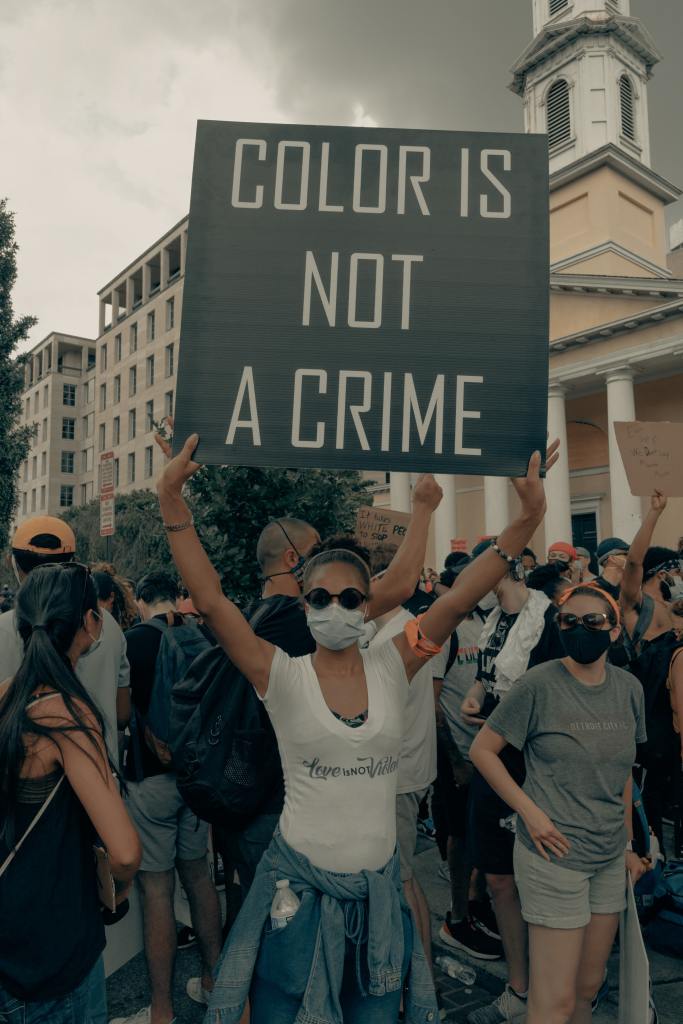
[Image description: a woman at a Black Lives Matter protest holds up a black and white sign that reads “COLOR IS NOT A CRIME”]
My experience the other day made me feel hurt, disrespected, and intimidated. I hate the thought that a security officer stereotyped me as a potential criminal after taking one look at me. I think the worst part is knowing that ultimately, it was the colour of my skin that did it (a pink dress with little flowers on it doesn’t exactly scream “terrorist”, but apparently brown skin does). It’s something that I can’t change, and something I shouldn’t have to change in order to be respected. What should change is the way people from ethnic minority backgrounds are treated.
The police have a Stop and Search framework which, in theory, they have to follow. I know for a fact this doesn’t always happen, and knowing your rights doesn’t help you a lot of the time. But the important thing is that we talk about these things and that we keep using social media to our advantage. Institutions like the Met Police should know that we are very much aware of the racism that underlies a lot of their practices. We need to keep speaking up for our communities and for those who are facing this kind of discrimination on a daily basis. The act of stereotyping is a much wider issue – one which I couldn’t address in a single post, but one I hope you will think about after reading this. Times are changing and we need to change too, on a societal, institutional, and individual level.
(Featured Photo by Jakayla Toney on Unsplash)
 Thivya K